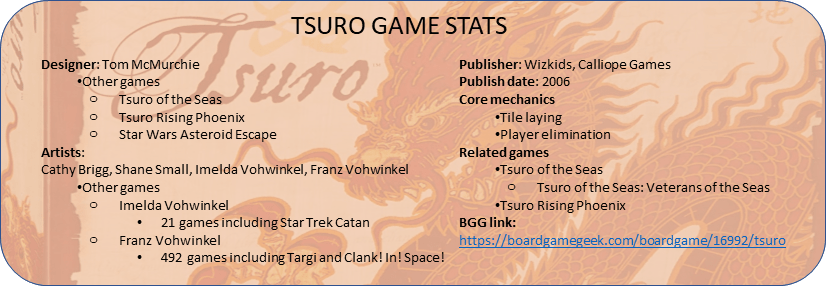
Sometimes when you play a game of any type, you just want something that’s light, quick to play, and can get a lot of people playing. It’s what we might call a filler game, a game that is played in between the longer games or at the beginning of a session to get everyone in the gaming mood. And that’s all there’s to them. Get motivated for a long night of games with friends. Until you stop to think about what’s going on and look at the symbolism. With Tsuro: The Path of the Dragon, a simple tile laying game, are we actually playing for the hand of a beautiful creature? Let’s dig into that.
Tsuro is an abstract tabletop board game for 2 to 8 players where players move their dragon pawn within a 6 by 6 grid on top of a beautifully drawn phoenix, with the hope of being the last one standing. Each player holds three tiles which they normally keep hidden from other players. Upon their turn, the player will place her tile down in front of her pawn and then move the pawn or pawns along the path on that card. After each pawn has been moved, if the player is still on the board, she would draw a new card from the draw deck. Play shifts clockwise to the next player. Play continues until there’s one player left or there are no tiles left to place. And sometimes, this leads to more than one winner which is a perfectly sound ending.
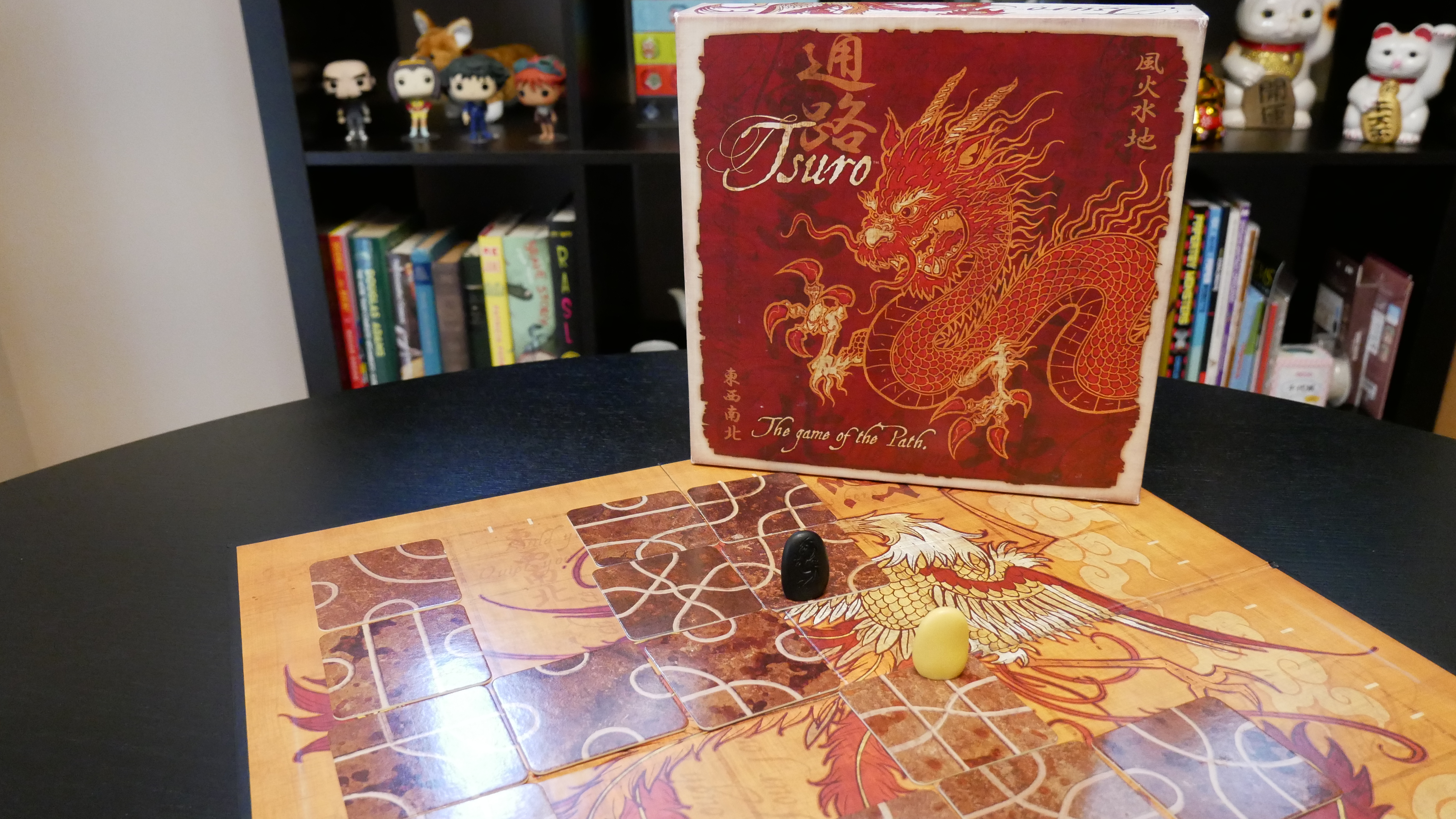
As complexity goes, it’s very entry level. Tsuro is a game that I usually bring out for new players given that it’s quick to pick up and doesn’t last too long. Most people want a second play afterwards. It’s simple and enjoyable which is one of the reasons I play it.
I mentioned that this is an abstract type of board game. What this means is that the objects used in the game has no direct relationship to a thing in the real world. Instead, the player moves along a tangled mess of lines that doesn’t have a clear meaning of what they are. But let’s start to unravel what it could be. And we must start at the name of the game.
According to Wikipedia, Tsuro (つうろ/通路) [1] is a Japanese word meaning route. With each tile put down, a clear line from the beginning is made. The end point is up to anyone’s guess. Each player is building a route based on decisions and limited information at the beginning and potential paths from their own hand. Each player may start at different locations along the edge of the board, but all things are equal. What we have here is what someone might have at the beginning of a big unknown adventure. Starting school, a career, or a relationship, whatever that might cross our paths, for good or for bad. But for a lot of games, this is a very standard starting point. We need to look at something less generic.

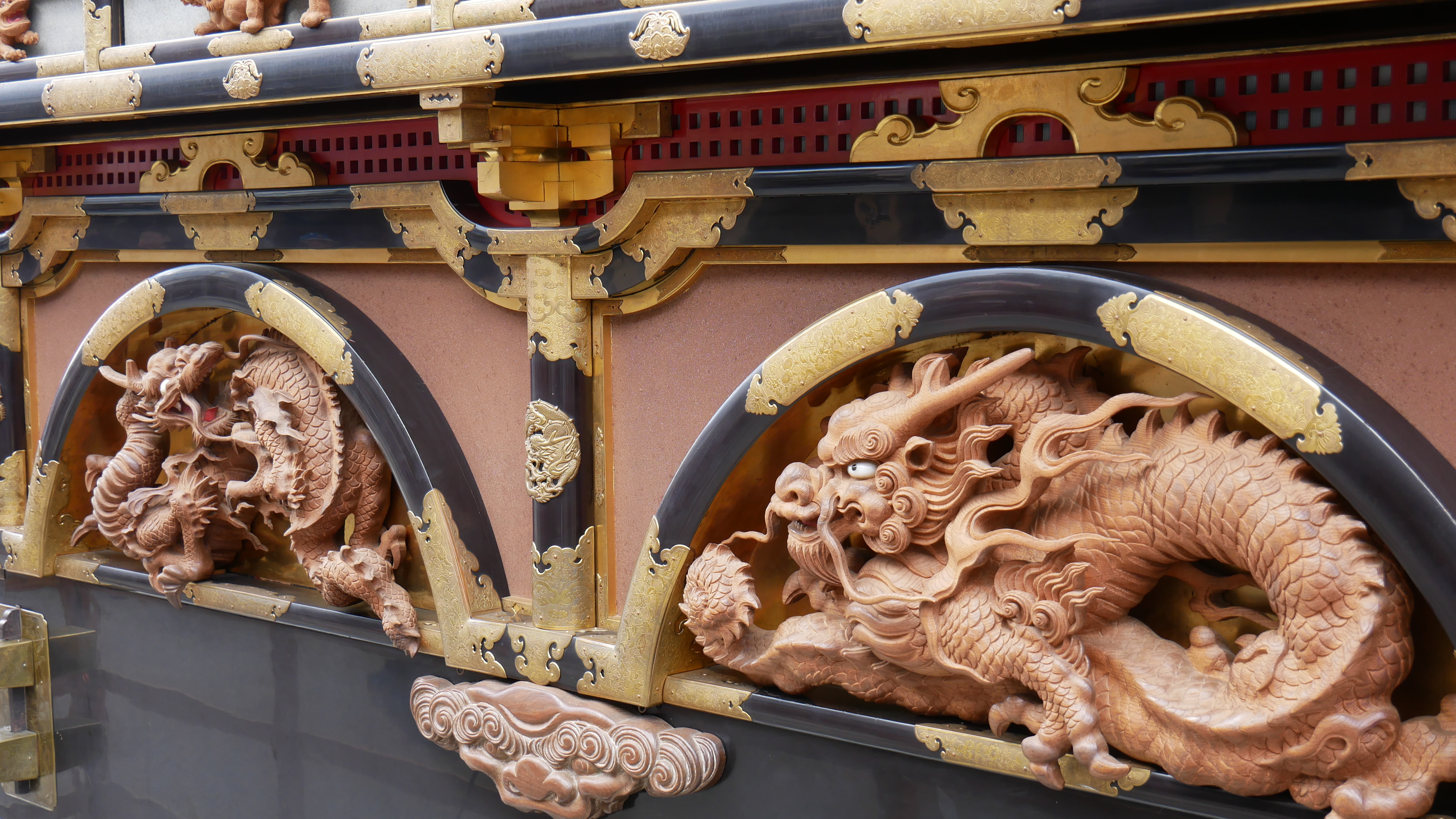
Let’s first look at the art which includes a depiction of a dragon and a phoenix, starting with the dragon. The Asian dragon is on the box, wonderfully presented in a sea of red with yellow and white highlights. Each player pawn is also etched with a minimalist version of the same style of dragon. My first thought was where did this dragon originate from. Based on the Japanese name of the game, I assumed it was Japanese. I also thought the phoenix was the rise from the fire and ashes type, but I’ll get to that shortly. I started my research looking up mythologies surrounding the Japanese dragon and there’s quite a bit.
I went down a rabbit hole of interesting things about how dragons are presented in Japanese culture. One part the dragon is featured is around Buddhism [2]. Dragons can be found as guardians of Buddha. There are also many different stories related to dragons including Toyotama-hime [3], where a prince broke a promise to his wife, and Benzaiten (Benten) [4], the only woman in the Seven Lucky Gods who tends to be accompanied by a water dragon (and may have some relation to the character Benten in the anime The Eccentric Family but that could be name only). But from what I could find, there wasn’t any kind of relationship with a phoenix.
The phoenix is featured on the game board, filling up most of a 6 x 6 grid. Five peacock like red tinged tail feathers fill about three quarters of the board, the last quarter with its body and thin neck leading up to its head. Yellow plumage covering the body and neck. It is fully exposed at the beginning of the game but is slowly covered with earthen colored etched tiles which fit precisely in each square. If all tiles are played, only one 1×1 grid is viewable. It’s highly visible which leads to some deeper meaning than looking great on the board.
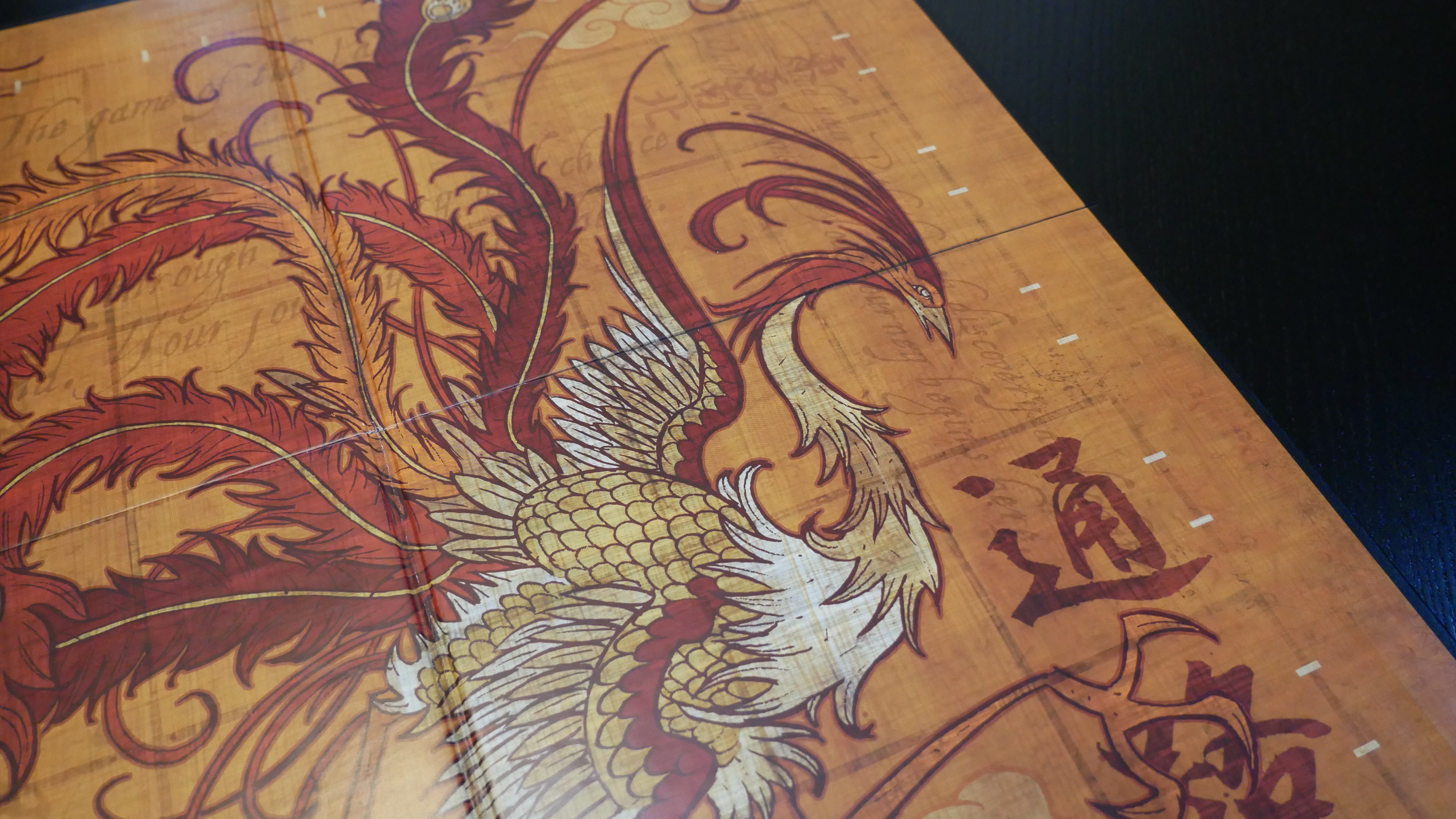
The phoenix we are mostly likely to think of is that of the Greek myth of a large bird who rises from the ashes. And there’s usually some flames and fire involved. In my research though, I learned the phoenix is represented in more than just one culture. The phoenix myth has also been in Egyptian, Native American, Chinese and Japanese mythologies [5]. With Japan still in mind, I started down that route.
And I didn’t get that far. If you do a search for images on Japanese phoenix, you get a whole lot of tattoos and not a lot of substance. What little I did find said that the myth probably came to Japan from China. The legend says that the phoenix, or Hō-ō [6], would descend from the heavens at the beginning of a new era. In the theme of Tsuro, there isn’t really a call for a new era. The phoenix of Japanese lore did not fit here.
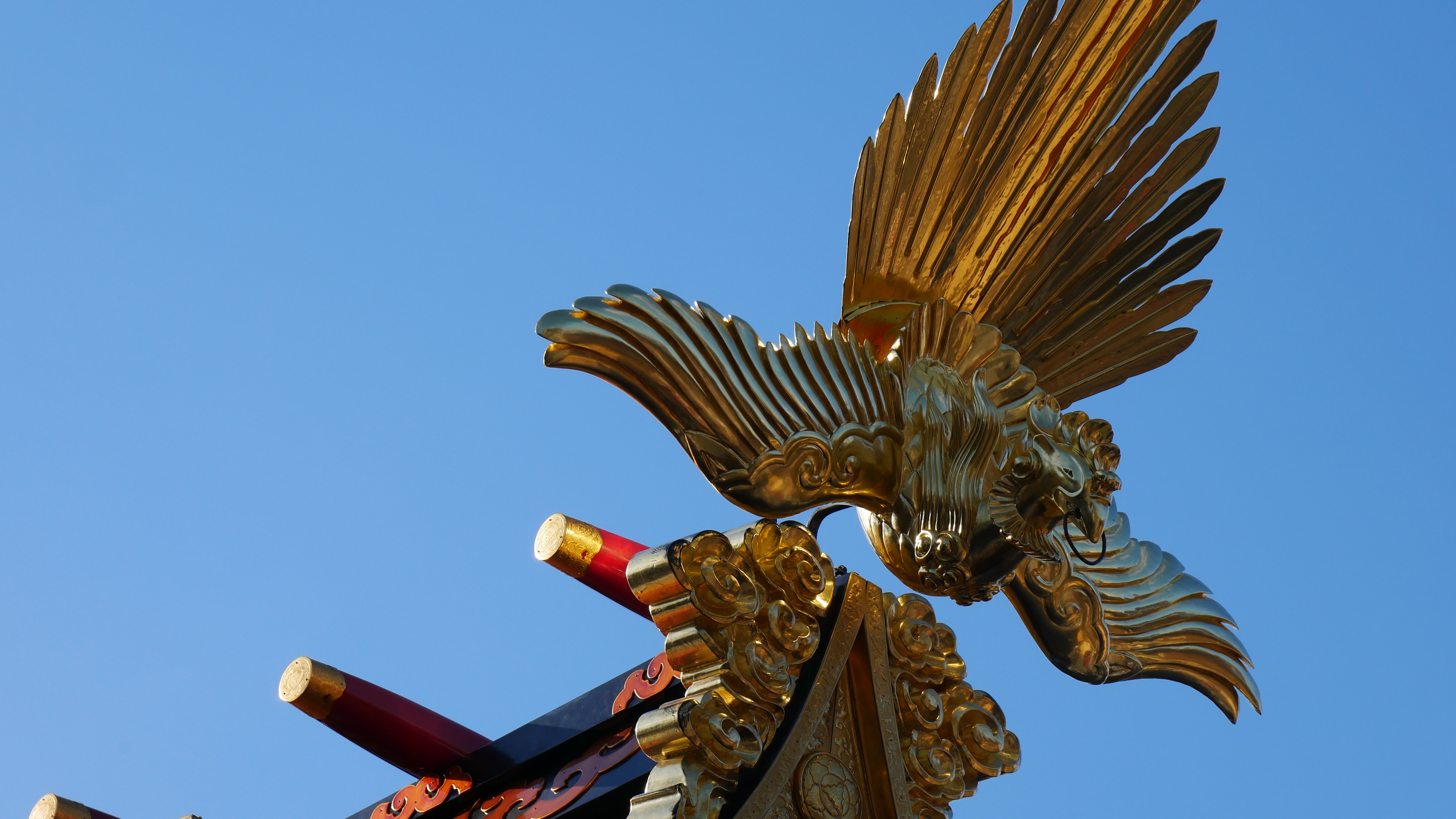
The way the dragon was drawn was also problematic. In the course of my research, it was typical for Japanese dragons to be shown with three toes. Chinese dragons were more commonly shown with four or five toes, with five being a symbol of royalty [7]. The Tsuro dragon is drawn with 4 toes. This led to me to think it was not of Japanese origin. I went looking at the Chinese mythology and well, the linkage is there.
In Feng Sheui, it is common for the phoenix and the dragon to be show together as a sort of yin and yang [8]. They were either considered mortal enemies or romantically together, or rather a symbol of marriage bliss. And here is where the game you thought you were playing is really something else.
So, what is yin and yang? Simply put, it’s the duality of opposing forces that actually complement each other [9]. One cannot exist without the other. Sort of the like within the Star Wars lore of the Force, there is no dark side without the light. Can’t have the Batman without The Joker. And in this case, the phoenix without the dragon.
The phoenix is the yin and the dragon is the yang. Traditionally, the yin component has been viewed as feminine and yang can be considered masculine. There are other interpretations that can be applied but for this dive into Tsuro, we’re using it.
To win the game, you must be the last pawn standing on the board. All the players are represented by dragon pawns, though. And each player is wanting to be the last one standing upon the phoenix in the twisty paths. From the traditional/classical/religious model of marriage or even the courtship, the players are suitors looking to be the winner for the hand of the female. Yes, we are competing for the heart of a woman.

Was this intentional by the game’s designer? A little hidden wink and a nod to the game playing public? What flavor text that is available to describe what backstory there might have been had talked about luck and destiny. If you watch and consume romantic media, comedic or otherwise, you could extrapolate out some phrases such as “I’m so lucky to have you” or “this was destiny.” Both of these induce eye rolling, at least in myself.
I have played Tsuro many a time and not once did it ever occur to me that the actions we all partook in was really a very simple tale of love. As you play through Tsuro, the hallmarks are there based on the meaning of the dragon and phoenix in Chinese mythology. The players see the competition on the board, each one hoping to be the last, to be alone with the phoenix.
The next time you play, keep an open heart. It may be crushed in the haphazard path of the dragon.
| [1] | Wikipedia, “Tsuro,” [Online]. Available: https://en.wikipedia.org/wiki/Tsuro . |
| [2] | Historyplex, “Historyplex,” [Online]. Available: https://historyplex.com/symbolism-of-dragons-in-japanese-culture. [Accessed 28 07 2020]. |
| [3] | Yabai Writers, “The Japanese Dragon – Myths, Legends, and Symbolisms,” [Online]. Available: http://yabai.com/p/2516. [Accessed 28 07 2020]. |
| [4] | S. Sanctum, “Benzaiten: White Snake Goddess of Japan,” 27 03 2017. [Online]. Available: http://serpentsanctum.com/benzaiten-white-snake-goddess-of-japan/. [Accessed 28 07 2020]. |
| [5] | P. Geller, “Phoenix,” 29 09 2018. [Online]. Available: https://mythology.net/mythical-creatures/phoenix/. [Accessed 07 28 2020]. |
| [6] | Wikipedia, “Fenghuang,” [Online]. Available: https://en.wikipedia.org/wiki/Fenghuang. [Accessed 28 07 2020]. |
| [7] | onmark productions, “Dragon,” [Online]. Available: https://www.onmarkproductions.com/html/dragon.shtml. [Accessed 28 07 2020]. |
| [8] | The Crabby Nook, “What does the dragon and phoenix symobolize in feng shui?,” [Online]. Available: https://www.thecrabbynook.com/what-does-the-dragon-and-phoenix-symbolize-in-feng-shui/. [Accessed 28 07 2020]. |
| [9] | Wikipedia, “Yin and yang,” [Online]. Available: https://en.wikipedia.org/wiki/Yin_and_yang. [Accessed 28 07 2020]. |
 A Wrinkle in Silver