
Mini-golf. The casual, for fun cousin of golf where you hit a ball into a little cup. You just don’t have to hit the ball 200 yards over sand traps and gophers. Instead, there are pipes, sharp corners, and a windmill or two. And probably animatronic alligators and clown heads. And it’s now your job to create the best one! For your clients because money makes the world go ’round!
Minigolf Designer puts you into the role of a designer for a minigolf course. A pair of clients have come with their aspirations and you need to do your best to make a fun 9 hole course while trying to appease their demands. And you’ll be doing that by placing tiles. It was Kickstarted by Thematic Game back in May of 2020 and started heading out to backers in November 2020.
Get a quick overview right here!
The Setup
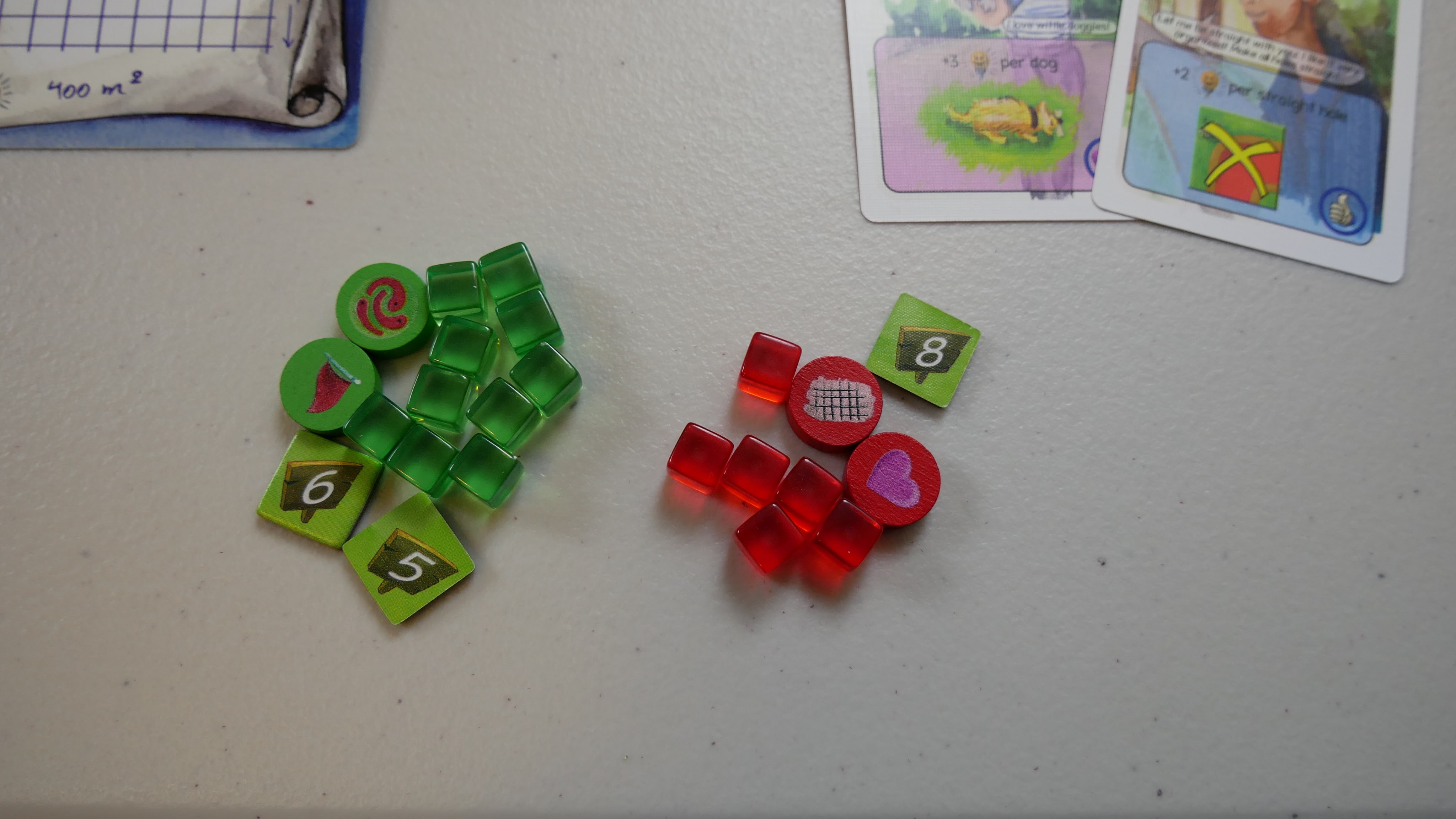
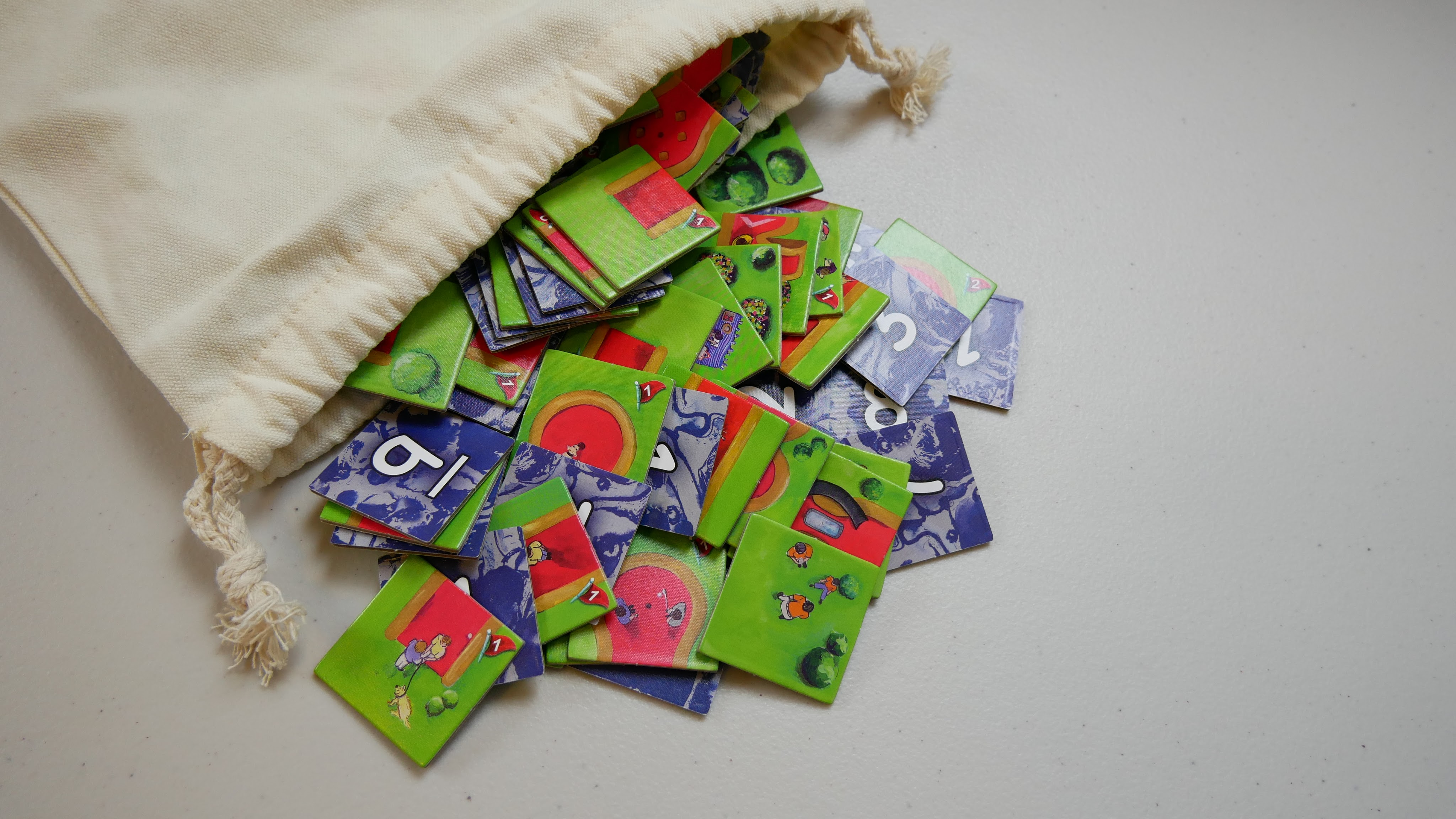
Each player will take a scorecard, a set of colored cubes and markers as the scorecard, their starting shack. Two client cards will be randomly selected, one for Mr and one for Mrs (and I will return to this) which will include bonus objectives for all players. The three rack used to hold the tiles are laid out. The player markers are placed randomly on the top rack and will determine player order. Tiles are drawn from the big bag and placed on each rack. And finally, each player gets 3 randomly land cards where 1 will be selected and the others returned to the box.

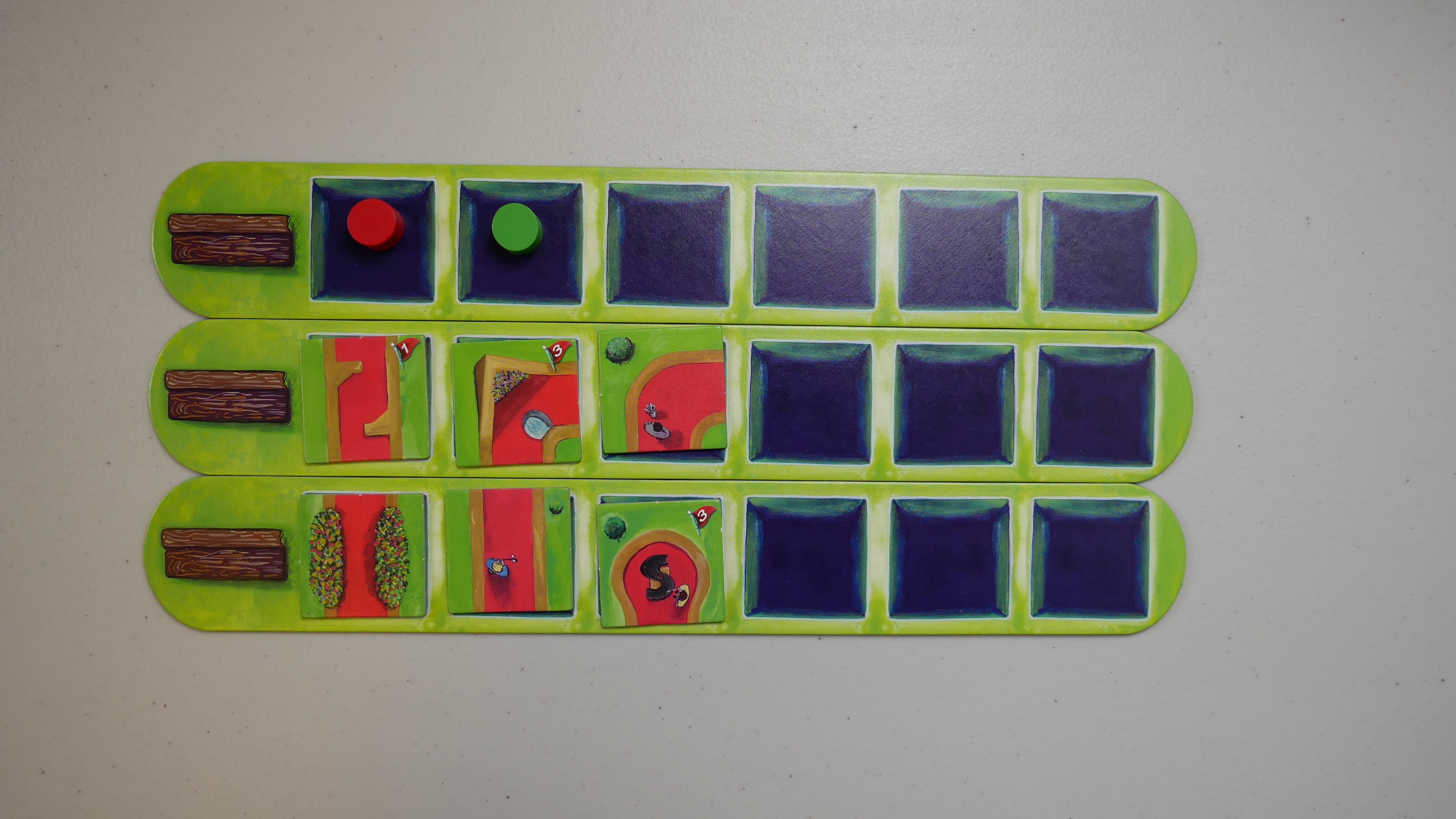
The Play
The first player will look at the middle rack and decide which tile they want. They pick that tile up and then move their player marker to that location on the middle rack. That location is the new player order. Once you have your tile, you place it on your play area by connecting to either the starting shack or an existing tile that is adjacent or diagonally touching. The next player then selects their tile until all players have done so. At this point, the top rack should only have one tile left. That tile is put back into the bag. The rack is then rotated to the bottom and refilled with new tiles. Play continues like this until all players decide to stop.
Oh, yeah, there are water tiles, too. However, they do nothing for scoring and just adds a completeness to the hole. Players can get them at any time. Water tiles are not legal places to play new tiles as new tiles must be played next to course pieces.
The Dreamy Bits
Dropping tiles is all fine and dandy but there must be some structure, rhyme and reason, goals to look to. You are, of course, building a mini golf course but it’s not the one of your dreams. It’s the dreams of your clients. You are building to get satisfactory points and the player with the most will win the game. How do you get those points? Follow these guidelines and your client may not fire you.
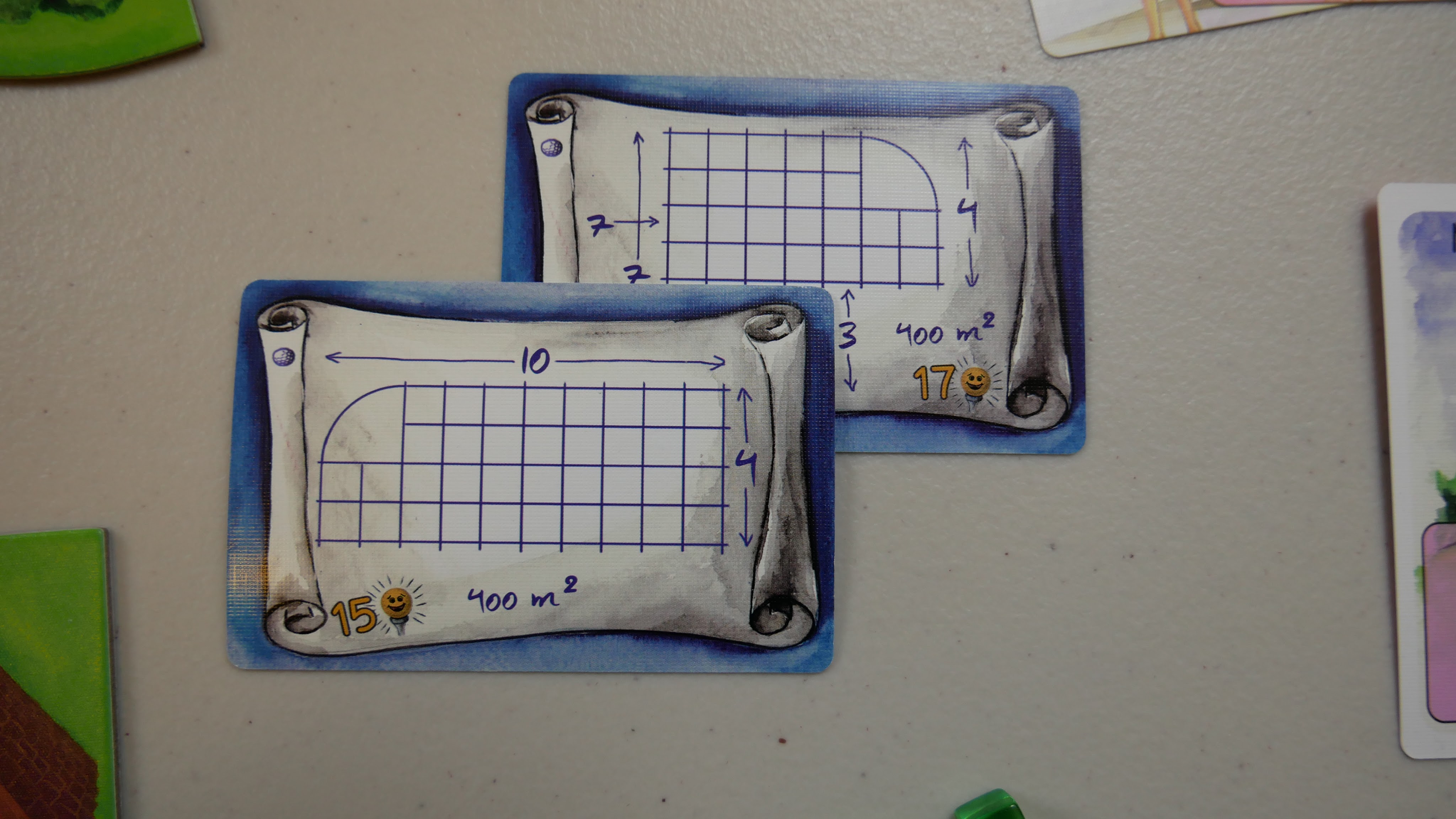
First up is the land card. This has three things on it to guide you to your best. One is the point value in the corner. This is the base max you can get for the course design. If you build outside the lines, so to speak, you’ll lose 3 points per tile outside the designated area. If you have missing tiles within the lines, then you’ll lose 1 point. Second are golf balls on the left side of the card showing the difficulty, from 1 to 3 with 3 being the hardest to complete. And finally, there’s a land area saying how many tiles it will take to complete. 400 m² will be 40 tiles.
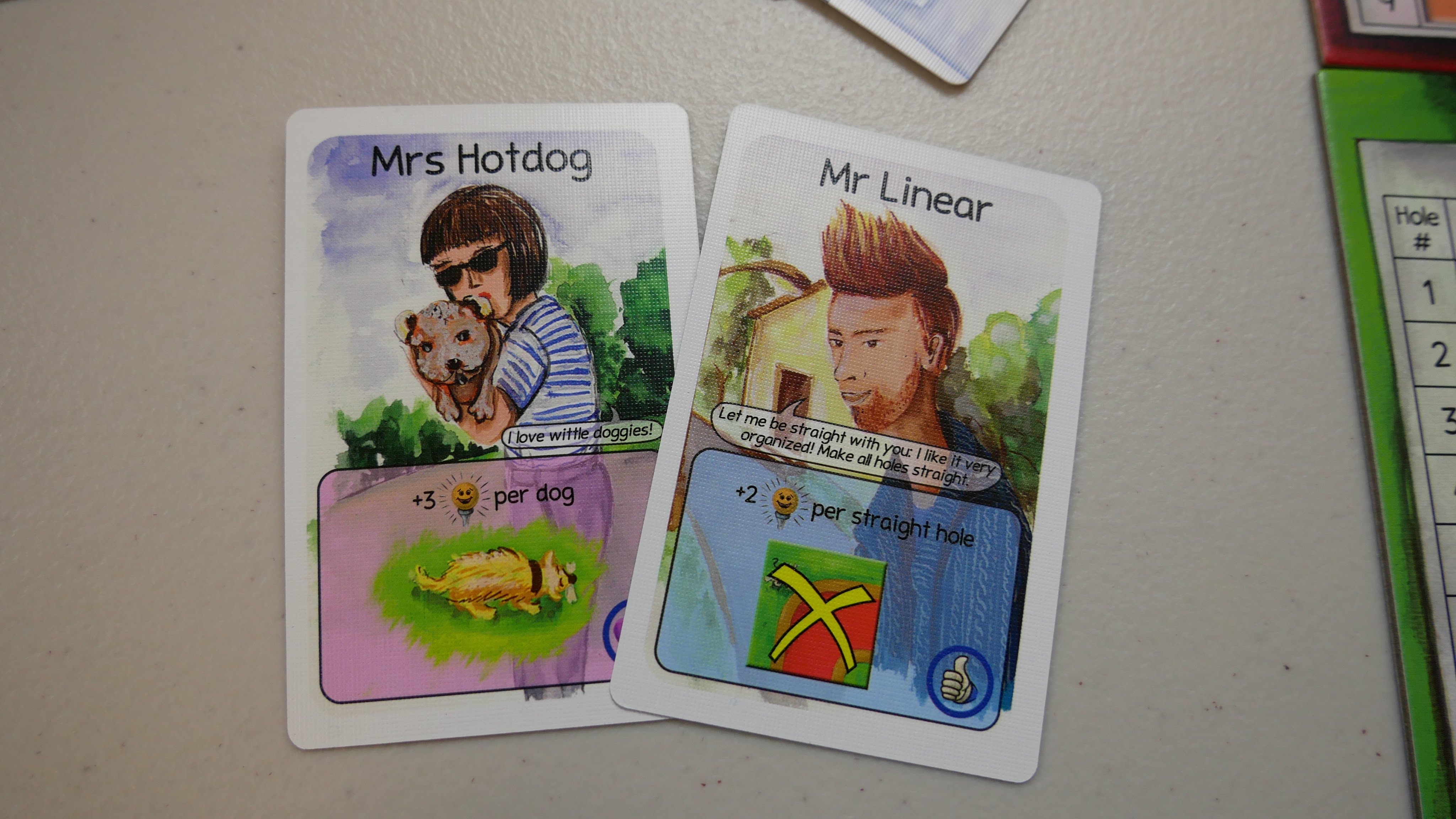
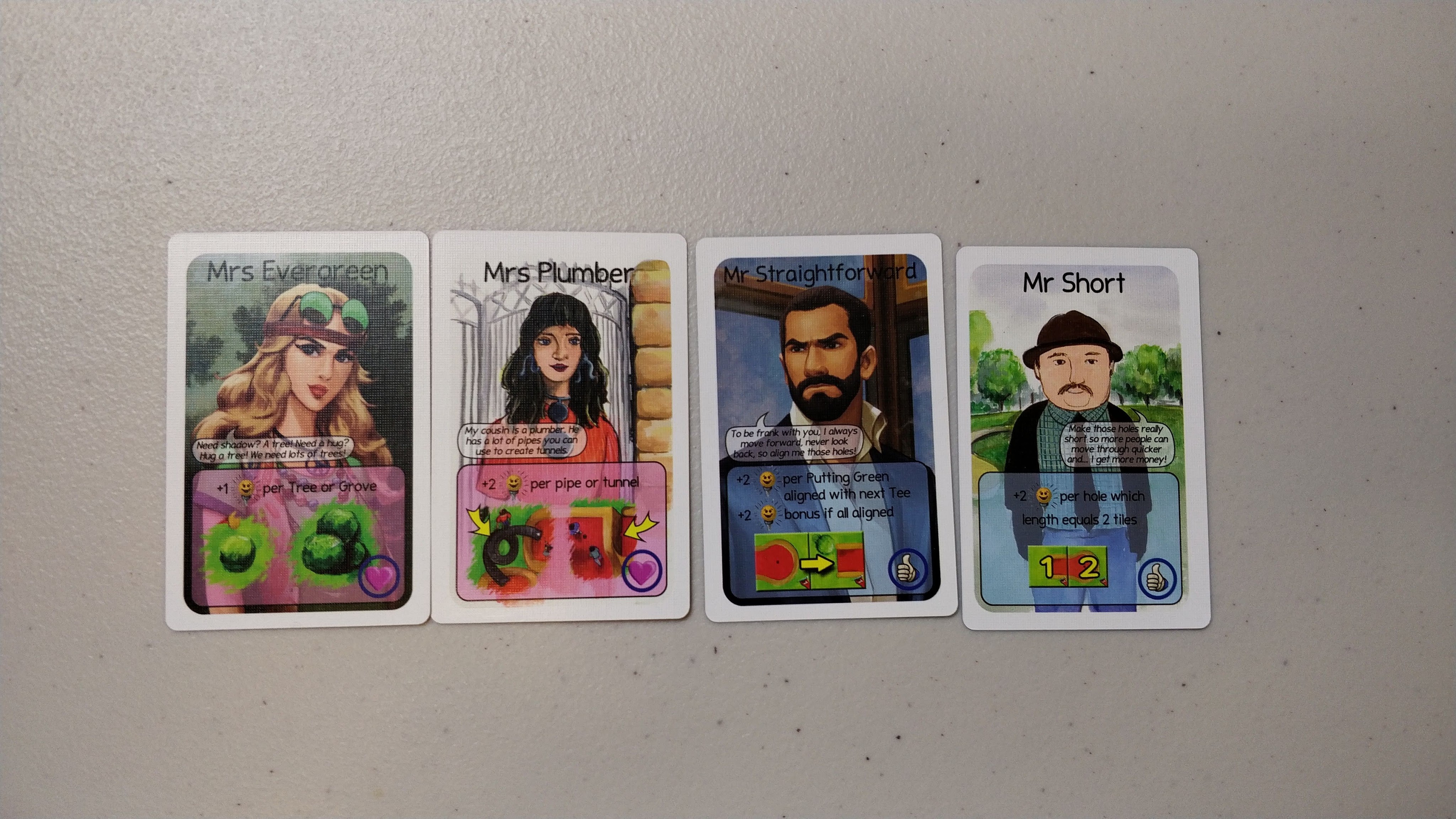
Next, there are features on the tiles that needs attention. For every person on a tile, the player will get 1 point. There can be other features that may come into play with the Mr and Mrs client cards. Mr client cards will focus on the build of the course like, for example, how many corners are on the course. The Mrs client cards will focus on the aesthetics of the course, for example, how many trees there are. Pay close attention to these to help maximize your good will with the clients.
Tiles may also include a flag with a number on it. This will be the number used to calculate the par for the hole. You’ll want to keep pars to the 3-5 range. For every hole in that range, you’ll get 2 points. There are 36 cubes per player used to track the par. If there are any cubes left over, you’ll lose points totaling the number of left over cubes. There are black cubes if more cubes are needed however, 1 point is lost for each black cube used. That 36 par is the sweet spot the clients are looking for. Try not to disappoint.
The clients also want to make sure the customers aren’t walking too far from hole to hole. 2 points are available if the putting green of the previous hole is adjacent to the tee of the next. This includes the shack.
And finally, the course needs to be playable. This is where lots of points can be lost. The clients want a 9 hole mini-golf course. Not 7, not 10. But 9. You’ll lose 10 points for every missing or extra hole. Each hole also needs exactly one tee and one putting green. The client will ding you 3 points per hole where this happens. They will also deduct 3 points for tiles that are mismatched. Green edge needs to connect to green edges and red connects to red.
And finally, deduct 1 point for each tile if the direction of the tile is incorrect. Arrows must always point towards the putting green. Can you imagine trying to putt up towards a small cliff and have it never get where it needs to go?
The clients aren’t all that strict and put in a clause about finishing early. If you do stop early and other players are still building, you can still take a tile but you do not place it. Each extra tile taken will net an additional 3 points.
All of the scoring happens at the end of the game. The person with the most satisfactory points is the master mini-golf designer. Are you ready to impress the clients with your vision?
There are advanced rules which do not change much of the gameplay but they do include a ranking on all the above scoring mechanisms. It’s a chance to get more points or actually lose points.
With all of this put together, you need to be aware of what you’re doing as you place your tile and the tiles that are selected. Given the random nature of what’s available, it could be a real mess. But that what makes this a good thinking game. King Domino is another game that employs the random tiles and player order mechanism, building within a confined area. And just like in King Domino, to be first, you will need to pay attention to all the players to see how they are doing. Do they need a putting green to finish a hole? Maybe you are trying to please one of the clients they grab something you needed? That’s where this game is going to make par, especially if King Domino is already in your game shack.
The Nightmare Bits
So what’s not to like about this game? There are a few things. I’m going to start with the Mr/Mrs clients. The theme of having a Mr and Mrs is problematic given that they have separate types of bonuses that can be awarded. The Mr with the build qualities of the course (marked with a thumbs up) and the Mrs with the aesthetics (marked as a heart). It’s a familiar sexist stereotype. I get what’s trying to be done but execution falls short.
Usually in a game, you need cubes to show changing resources over time, things that might fluctuate a lot. The cubes here are used to show your par for a course. They are being used to track your max par which should be 36 on the nose. I mean, this is fine to track as a resource but you put the cubes on a flat card. If you have done any board gaming, one little bump and those little pieces are all over. The cube are necessary because scoring doesn’t happen until the end of the game. Once the hole has been completed, the par for the hole will not change and cubes sit around, waiting for disaster to strike.
As mentioned in the dreamy bits, all scoring happens at the end. There is a huge scoring track which is only used at the end. It takes up a lot of space which happens to be the same width and length as the box. It seems kind of needless, like having your flip flops on while walking in a sea of lava. I understand not scoring at the end of a game to help with runaway leader issues but I find it difficult to see how that would happen in this game given the randomness of tiles.
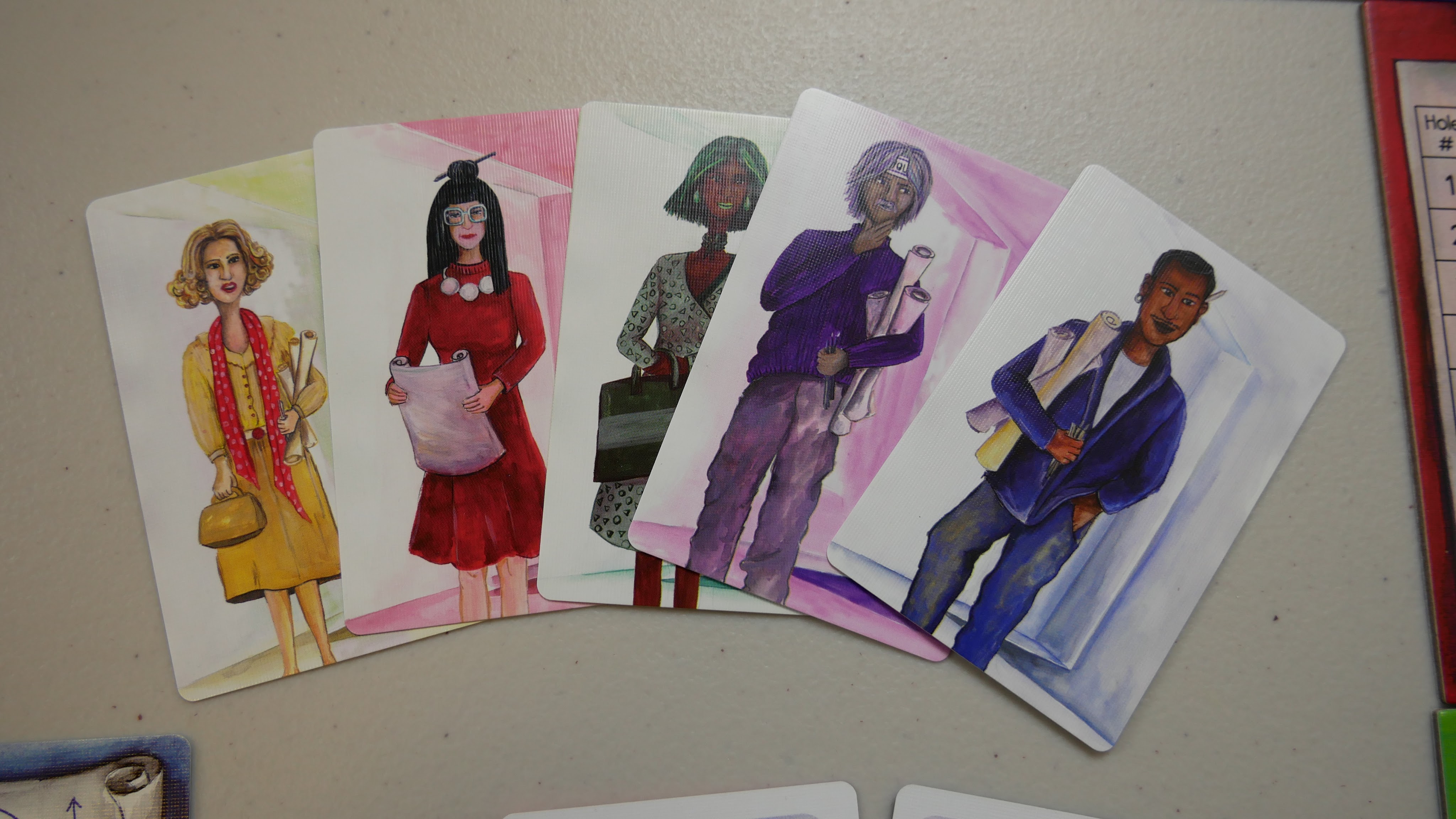
While not a killer point for me, the art could be an eye sore for some. The course tiles are alright and shows enough details to give a sense of what the course will be like. The art for the clients and player cards are a little rough. Those cards are not something you’ll be looking at a lot but when you do, it won’t bring joy. There are two client cards seem to be have been done by a different artist from the rest of the game. Mrs Evergreen and Mr Straightforward and drawn more realistically than the others. Kind of an odd play and I didn’t notice it right away. They began to stick out though.
And finally, not really a nightmare but one of those feelings of falling asleep and you are jolted awake kind of things. The plastic molded insert is almost perfect. Almost. There’s a place for everything and there are included bags to separate the player pieces (which took some time to separate). But two things just didn’t quite work. With the sections for the cards, the last card in the bottom can be stuck as the indention for your finger doesn’t quite go all the way to the bottom. You will have to spend a bit of extra time to get it out. There are tiles for the water hazards and an mold for that, but are not deep enough. You will need to find a home for about 10 of them. Again, these are annoyances and the insert is a great step up from other games.
The Lucid Bits
The nightmare is over but if we are to play again, what are some things that could change for the better? Let me hit each one starting with the Mr/Mrs clients.
The intent of those cards was to provide bonuses. From a theme point of view, it should be a single client with a mix of various folks and that client would have two requirements. Drop the Mr/Mrs and call the bonus points what they are: for construction and aesthetics. The segregation of gender is certainly not needed here.
None of the cards have a downside, either. Perhaps the client would have a negative if you don’t have a certain number of the bonus tiles in place. And clients could be represented as hard to work with (more negatives) or easy to work with (less or no negatives).
Now, time for scoring. Why you can’t score as you lay a tile is beyond me. There are many points in the game which can be scored as a tile is dropped. This includes:
- The number of people on a tile
- Did the par fall in range of 3-5 on a complete hole
- Did you form a circuit
- The bonus points from the client cards
Scoring at the end of player’s turn will give you a bit more to do and seeing how others are stacking up during the game will most likely affect what you play assuming the score is something you’re after.
With the scoring change, why is there a need for the scorecard? Each player can still have 36 cubes but instead of putting the cube on a score card, return the number of cubes for par back to a used pile. If you need more, take a black cube which can be scored at the end. The scorecard is on theme if you were playing a round of mini-golf but with building, there doesn’t seem to be a need.
Waking up
Ok, so the game is in the same style as King Domino or Carcassonne. Get a tile, play the tile according the rules and score at the end. There isn’t really anything new or different here. But that’s ok. If you like mini-golf as a theme and enjoy the strategic placement of tiles, there’s something here for you. I will probably house rule the scoring portion to allow scoring those four elements as they are played.
Since it was a Kickstarter game, you will not find it at your local Target or Friendly Local Game Store (FLGS). Looks like late pledges are open so if this looks like your swing (FORE!!!), check it out at the Minigolf Designer Kickstarter page.
 A Wrinkle in Silver
Hello,
The water tiles are supposed to be stored vertically in the thermoforming insert. The two small square holes next to them are for the six 100/200 tiles, and the six client visit tiles (stored horizontally). There is enough space for all the extra tiles to fit there, without the need to find them another space.
You can definitely score while playing, and the promise disks can be used for that purpose. For example every time you place a tile with people on it, you can move your promise disk with the people logo on the score track. This comes handy when you play the advanced version, as you can immediately see which player is ahead on every condition when there is a client visit (this is actually recommended for competitive players).
As for having only one client card with two conditions, considering that there are 7 male and 7 female clients, that makes 7×7 = 49 possible combinations, which means we should have 49 different client cards in the box to have the same variety.
Yours.
LikeLike
Thanks for the heads up on how the tiles should be stored. Didn’t think to go vertical. Having the insert in there with places to put everything is handy. And as for the bonus conditions, I understand the intent of having different combinations (and I should probably be more clear on what I meant) was to provide different bonuses. My issue was really with how it was presented as male and female, with the male cards being just for course construction and the female cards being for how the course looks. It’s the stereotype of guys build and girls look pretty. It’s a theme thing and doesn’t affect gameplay.
LikeLike